


Greenbelt Biota, a Facebook group of 394 members as of July 2020, calls itself Greenbelt’s Natural History Society. and indeed these folks KNOW the critters and plants of Greenbelt like nobody else. (They’re also one of the first to get listed here on the Directory of Greenbelts Organizations.)
Their most popular events are the monthly nature walks through Greenbelt’s Forest Preserve. But rather than try to make that socially distant – difficult along the narrow paths – they decided to go virtual with a self-guided tour. So the experience is still in nature, but without fellow hikers.
Walk organizer Catherine Plaisant calls this “a new way to do our biota/nature walks in time of coronavirus – by having a Temporary (Ephemeral?) Self-guided Plant Walk. It’s shorter and more accessible than our most common walks that are long and off trail, so this is also a way to bring different people to do a walk.”

The first Self-Guided Walk, June 27-29, was a test of the technology, signage and other details needed to make it work, so it was only advertised among Greenbelt Biota members, feedback about which would be used to improve the experience next time. Catherine wrote to me that “If it works well it may be adaptable to other area places/parks/gardens. Or just repeated at the same place for a different group.” She calls the test “free and simple,” using an “easy trail where (I hope) no one would get lost or exhausted, near my house because it is easier.”
She writes that she “took photos of plants while walking the trail, filled a Google Slides document with one plant per slide/page, made sure the aspect ratio and size was readable on a phone, printed the slides 6 per page to get a PDF for people who prefer that, wrote instructions, and created a Facebook event. Fancier tools would include things like a map and GPS positioning, links to details, audio recordings etc but it is not essential for an informal volunteer activity.”
Instructions on the Facebook event page included details like where to start, the total distance (.4 mile one way), the number of plants identified (29), each marked with a numbered flag, and how to follow the tour, The options were uploading the google doc to your phone, seeing the plants in a browser, or by printing a PDF file.
The flags with numbers are the temporary part of the tour – they only stayed up three days.About the plants, Catherine wrote that “I tried to mix classic plants we all need to know (e.g., poison ivy to start) and less common plants.” Text describing the plants includes many references to Owen Kelley’s book “A Hundred Wild Things” in which he reviews the plants found in our woods.” Following the book isn’t necessary but definitely helpful.
I took the walk at sunrise on Sunday morning of the 3-day event and loved it! Hope to see more.
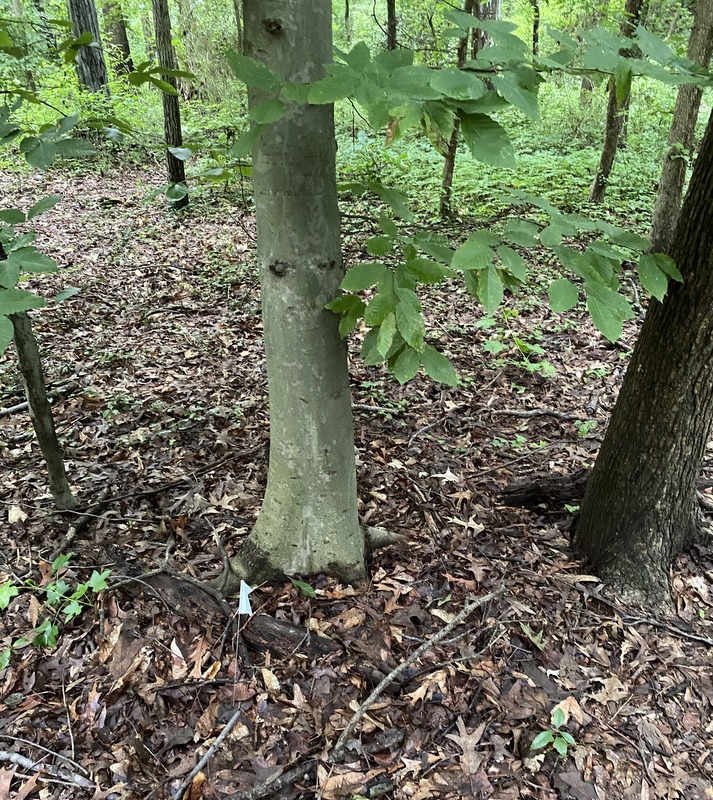
For this American beech, the text tells us to “Notice how very little is growing under it.” That’s because they produce a chemical into the soil which inhibits the growth of other plants (a biological phenomena called allelopathy )
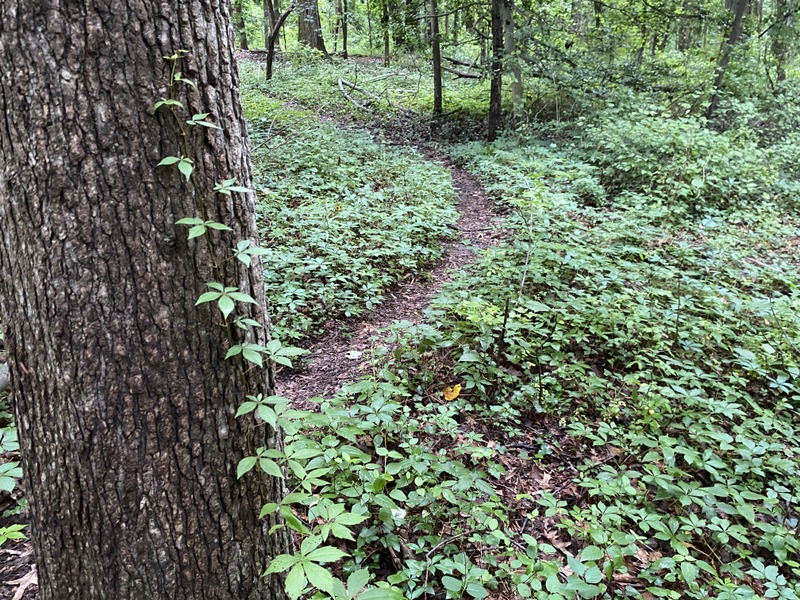
Virginia Creeper.(Parthenocissus quinquefolia.)

From left: New York Fern (Thelypteris noveboracensis) and Christmas Fern (Polystichum acrostichoides.)