


Preparing for the Inspection Means Less Hassle for you, Less Expense for our Co-op
by GHI Members Susan Harris and Catherine Plaisant
Nobody’s a fan of yard inspections but they’re here to stay because they enforce rules that were developed with input from or at the suggestion of the members to benefit our community, rules that we promised to follow when we joined the cooperative and received a copy of the Member Handbook.
The purpose of this article is to help GHI members prepare for the inspection and understand the rules underlying the inspection. We review each of the items or deficiencies you might be cited for based on the new 2026 inspection form, and suggest how to prepare for that specific item. Each item is directly linked to the rules described in the member handbook.
This article does NOT discuss any suggestions for changes to the inspection process or the underling rules. The goal here is member education in hopes of a smoother process for all in 2026.
How it benefits you to fix your yard problem BEFORE the first inspection
The yards of all members of Greenbelt Homes will be inspected by staff, beginning in the second week of May this year. But we hope you read this before then and find out how to prepare, which should reduce the mystery and dread about the inspection and enable you to pass the first time. That benefits you and reduces staff time.
After your yard is inspected, the notice left at your door will either say your yard passed or if it didn’t, it’ll include a:”Final Inspection date” as few as seven calendar days later (sometimes more). Failing the final inspection “will trigger assignments of GHI staff or a subcontractor to correct the cited item after two calendar weeks. Work activity will be scheduled with written notification given with a final inspection fail. Members will be responsible for any fees incurred, including trip charges. A minimum fee of $87 may be imposed per hour of labor per staff member and could be greater depending upon materials needed and the nature of the citation.”
You might be able to find someone to do the work for less, or do it yourself or with the help of a friend. Or you might be super-busy or sick or traveling during the period given to you to make the repairs – which would turn the repairs into a bigger hassle and cause anxiety.
So checking for problems and fixing them NOW can make it easier and cheaper for you, and definitely reduces the cost of this program that we all pay for.
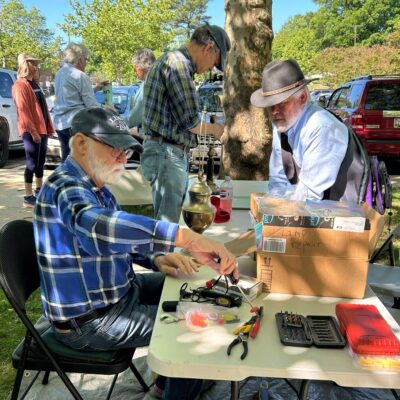
The GHI Member Handbook is available in Yardi or just click here. Some tools (extension ladders, scrub brushes and extension poles) are available to borrow from GHI, free of charge. Some paints and house numbers (stick-on 3″ tall) are also provided free at the Maintenance Department. Tools can also be borrowed from the Greenbelt Markerspace and Tool Library.
Can you know when YOUR yard will be inspected?
GHI’s weekly eNews will announce the courts that will be inspected next, and we can follow the inspectors’ route. No paper notification is sent, and staff will not call you when the inspectors reach your home.
Problems your yard can be cited for, and how to prevent that
(Click to see what the 2026 Yard Inspection Form will look like, as approved by the Board. Below, we’ve grouped the items by subject matter.)
Plant-Related Citations
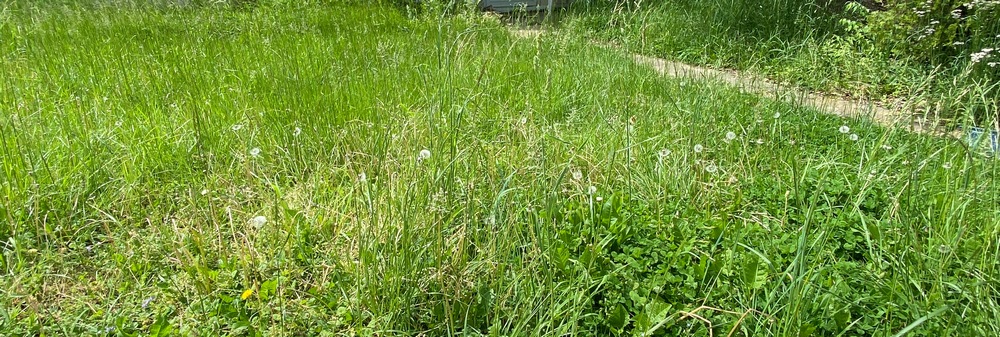
(1) Lawn height exceeds 8 inches.
[Section 2.5.5. of the Member Handbook: “A lawn must be cut before it exceeds a height of eight inches.”]
To Prepare: Make sure you mow your lawn. Even a weedwacker will do the job in a small yard, but best to use a mower if possible. Borrow one from a neighbor if needed.
Tips: The handbook rule uses the term “lawn” not grass, so you should not be cited for tall ornamental grasses or a pollinator garden containing grasses or sedges – as long as it is visually obvious that it is a garden bed and not a lawn. On the other hand if your entire front yard is a tangle of untidy plants with some grass in it, don’t be surprised if yard inspectors see it as an unkept lawn over 8” and cite you.
The best way to prepare is to tend to your garden so it clearly looks maintained. It will save you a citation, and may even save your plants if GHI decides that you have not corrected the issue in time and sends staff to cut everything and charge you for doing it.
Resources:
- Learn the “Cues to Care” that make your yard look like a garden, not an abandoned site, written by Susan just for GHI members.
- See attractive GHI front (service-side) yards with no lawn at all. They use cues to care! And browse other photo albums on the site for hundreds more “lawnless front yards.”
(2) Leaves on lawn or walkway
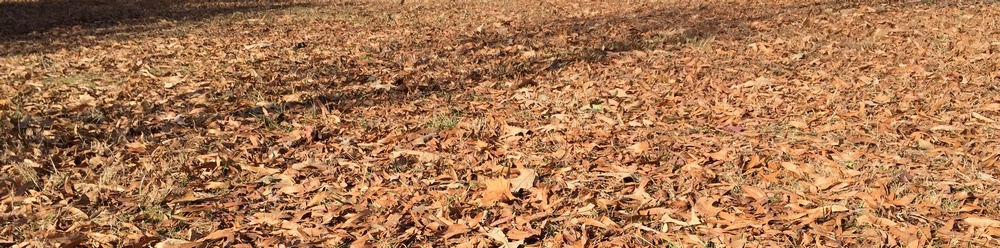
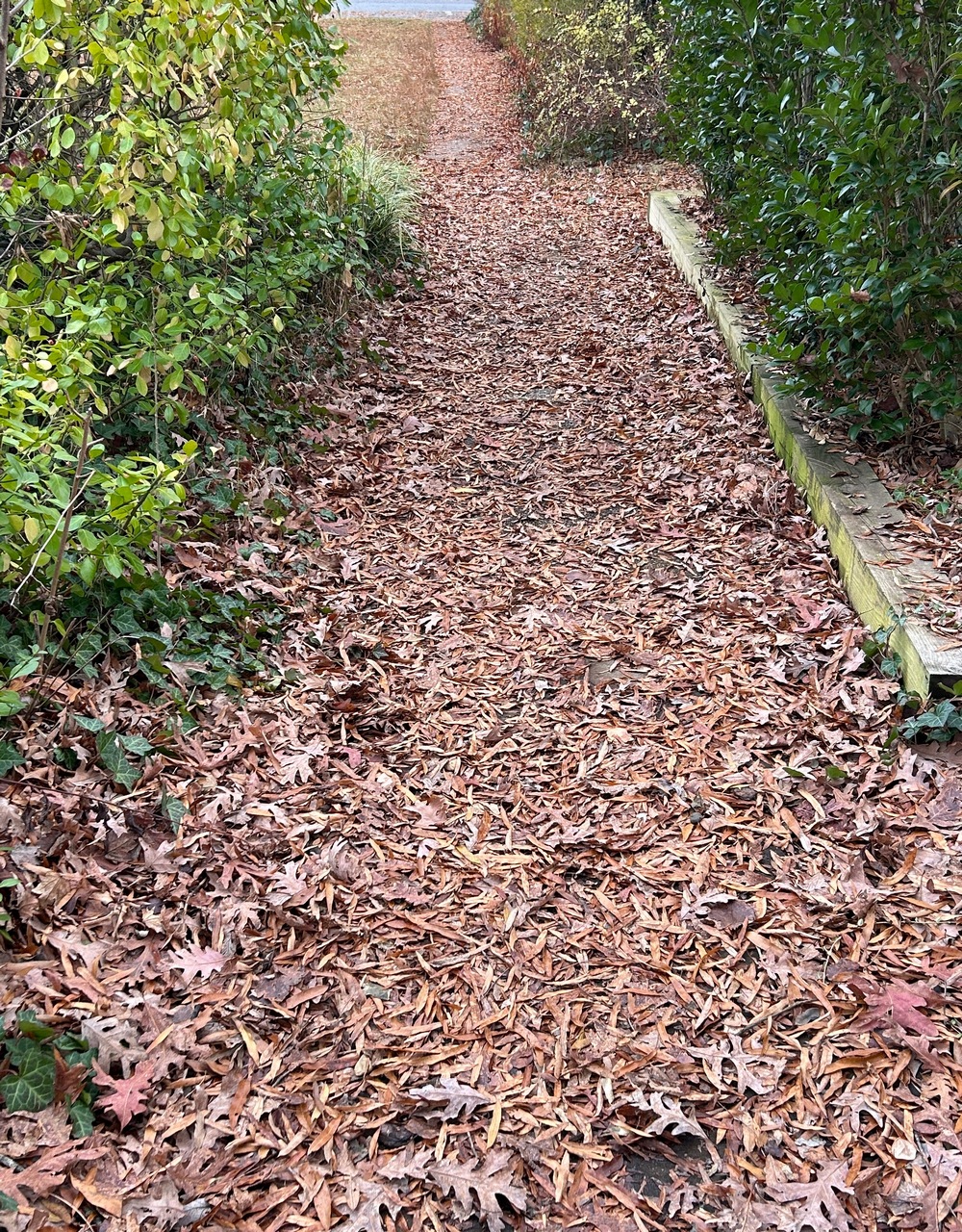
[Section 2.5.2 reads “Yard areas must be neat in appearance and free of trash and debris, and lawns free of leaves. Leaves need not be raked in yards that are wooded and have no lawn and in clearly defined flower beds.” Also 2.5.3 reads: “Walkways must be maintained in a safe and proper condition. They must be kept free of obstructions such as ice, snow, leaves, litter, and vegetation.”]
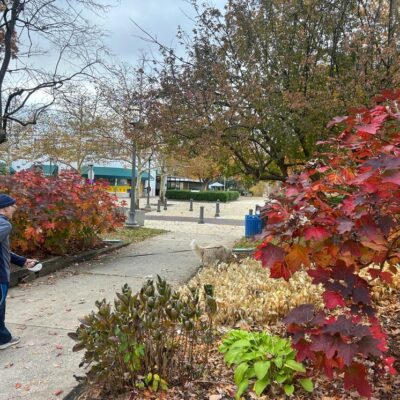
To Prepare: Rake leaves that are still on your lawn and on the walkways adjacent to your yard, and please rake the walkways in December or January, for safety’s sake. Don’t wait ’til spring.
Tips/resources: “Leave the leaves” is a popular meme but it’s not intended for lawns, which are easily damaged by over 20 percent coverage of leaves left over the winter. A light covering of leaves could be mulch-mowed and left on the lawn. Chopped-up leaves will improve the soil and do not harm to the lawn (but the process kills the insects wintering in the leaves). More from UMinn.
Leaves are allowed be left in place in clearly defined flower beds. Make sure that anyone can tell – at a glance – that your plantings or pollinator gardens are beds and NOT a messy lawn. Delineating the beds with a mowed grassy area, a path of grass, mulch or pavers, a rock border or a small fence will help. Plants tend to hold leaves in place, but be mindful that leaves from your beds might still blow on neighboring lawns.
Leaves can be composted, but see Section 6.2.1.3 which says: “Compost piles must be enclosed and screened (hidden from view) by plants or fences. Members must get a GHI Type II permit request approved by the Technical Services Department to maintain more than one compost pile or a pile larger than six feet by six feet.”
(5) Shrubs, hedges and other plantings overhanging walkways
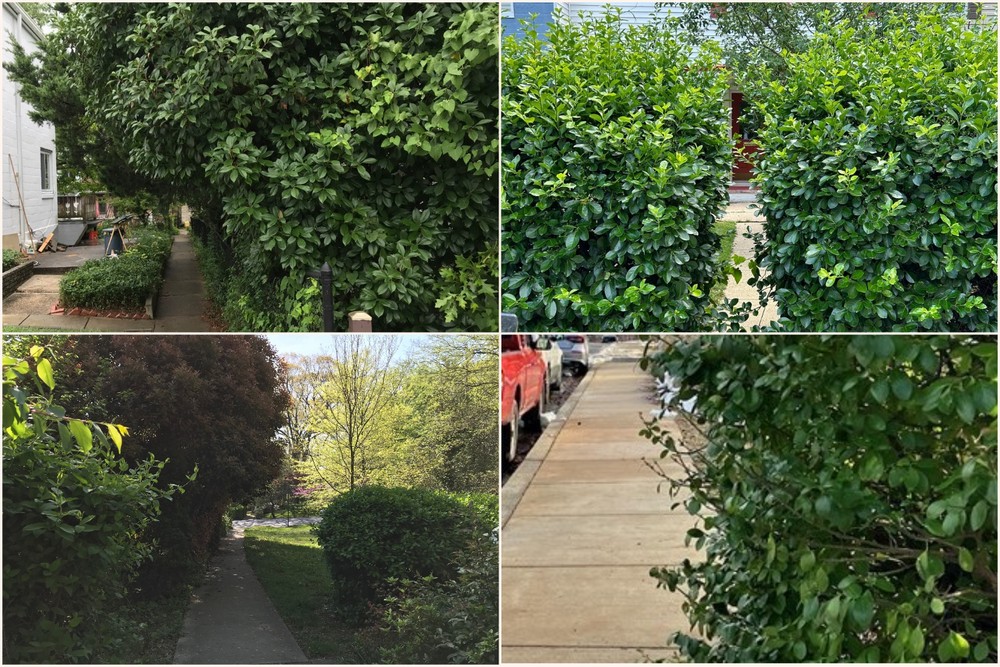
Clearing the walkways is a safety issue. Obstructions abound, and not just for the visually impaired. Branches can tear our skin and clothes, ticks can fall on us when we brush against vegetation on the narrowed walkways, and so on. When members are asked informally what rule-infractions they’d like to see better enforced, making our sidewalks safer is the number one answer (The second-most mentioned is truly fixing the worst-of-the-worst yards.)
Section 2.5.3 “Walkways” of the handbook reads: “Walkways must be maintained in a safe and proper condition. They must be kept free of obstructions such as ice, snow, leaves, litter, and vegetation. All shrubs, hedges, and other plantings must be trimmed in an orderly fashion and not overhang walkways nor common areas in accordance with Section 2.5.5.3. Plantings adjacent to walkways that have become so overgrown as to be unmanageable must be removed.”
To Prepare: Prune your shrubs! The sentence “planting should not overhang the walkway” means that not a single branch should extend past the vertical plane above the edge of the walkway. No minimal height is specified in the handbook, but really… a tall person should not have to bend down under our trees and shrubs, even when it rains. Just for reference the Greenbelt City Code Section 18.3. about walkways says to clear 8′ above walkways.
Tips and resources:
Hedges are high-maintenance – no doubt about it. And pruning is an acquired skill, not intuitive at all. So Greenbelt Online hired a professional to show us how to prune hedges. Click here to read/watch one expert’s instruction for GHIers in particular. To learn basic pruning, there’s lots of great videos – here are pruning videos by universities.
What about city sidewalks? “Our understanding is that GHI cannot enforce on walkways or sidewalks owned by the city, so you may not be cited. BUT the city has the same rule about vegetation not being allowed to overhang over walkways… so let’s all be good citizens and trim the vegetation that overhangs ALL the walkways and sidewalks adjacent to our yard so we can all enjoy a walkable neighborhood. Click to see a MAP of GHI versus City sidewalks and walkways.
(8) Clear vegetation/yard debris/litter from edge of walkways
[Section. 2.5.3.2. lists as member responsibilities: “Vegetation must be kept trimmed back from the edge of walkways. On shared access walkways, the responsibility for maintaining walkways is shared with adjacent neighbors.”]
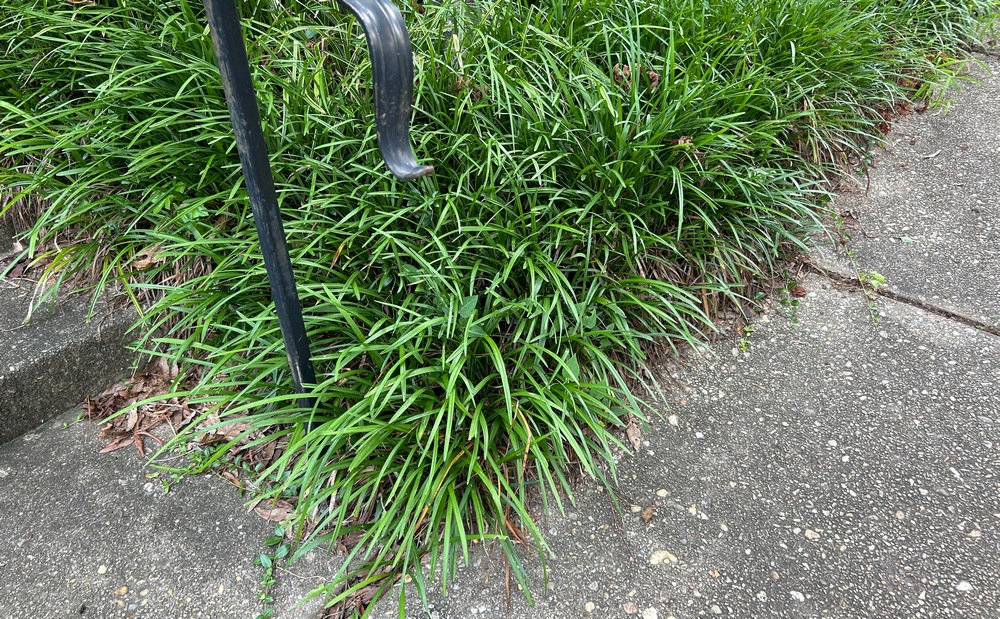
Understanding the focus of these rules to be keeping our walkways in “safe and proper condition,” we’ve encouraged the staff to focus the citations on hazards like slippery leaves and overhanging branches, rather than on short groundcovers that “overhang” by an inch or two. After all, groundcovers are the best plants for members to plant along walkways – they prevent weeds and erosion without causing a hazardous situation.
(7) English ivy/non-native wisteria on tree or structure. Bamboo escaping yard. Poison ivy.
Though the member handbook has a long list of prohibited invasive plant species that members “should eradicate” and “should not introduce,” the handbook and the yard Inspection form only include three species that “must” be controlled: English ivy, non native wisteria and running bamboo.
Poison ivy is a native plant that is beneficial to wildlife and belongs to the woods (so it’s not an invasive species in the common sense of the word), but everyone agrees that to protect us humans it should be removed from yards. It is the rule!
On the inspection form Section 2.5.5.4.4 is mistakenly listed as the rule supporting this citation. The rule about these plants begin at Sec 2.5.5.5.
There’s no mention in the handbook of an interdiction to grow vines on fences; and fences are not listed as example of structures anywhere, so we believe that vines (other than poison ivy) are okay on fences.
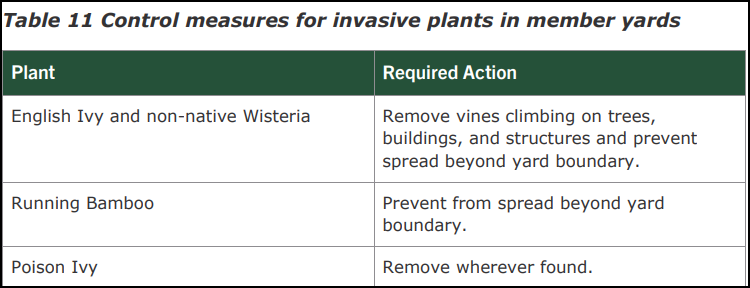
To prepare:
- Remove all English ivy or nonnative wisteria from trees and structures, and stop it from spreading beyond your yard. More info: UMD for ivy. and UMD for Wisteria
- Remove any running bamboo that’s escaping your yard. More info: MissouriBotanic.
- Get rid of any poison ivy in your yard, including on the outside of hedges near the walkways. (Via UMD, scroll down to “Controlling and protecting”.)
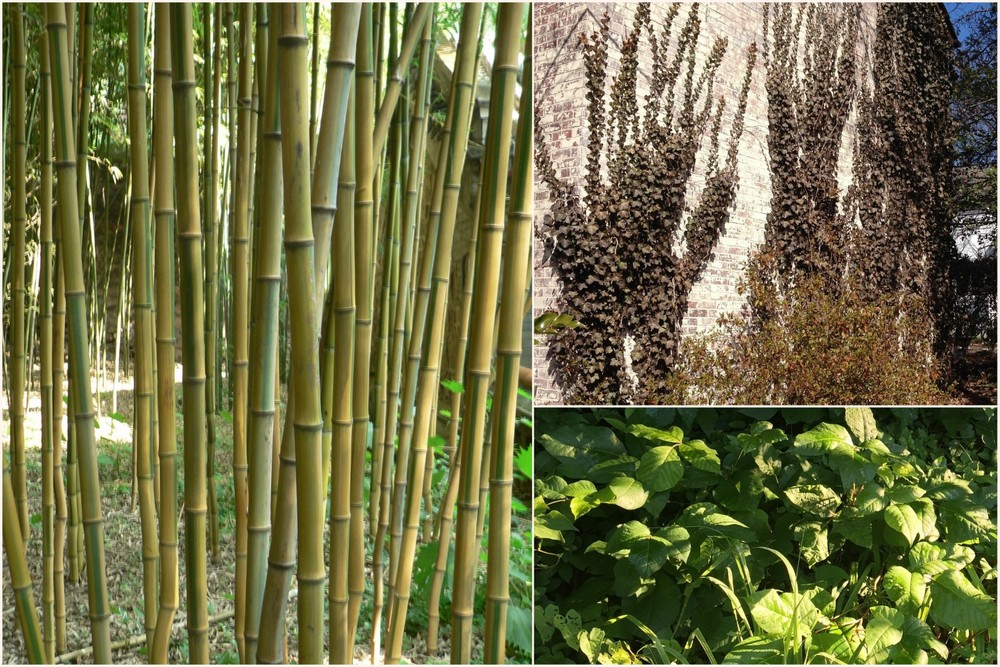
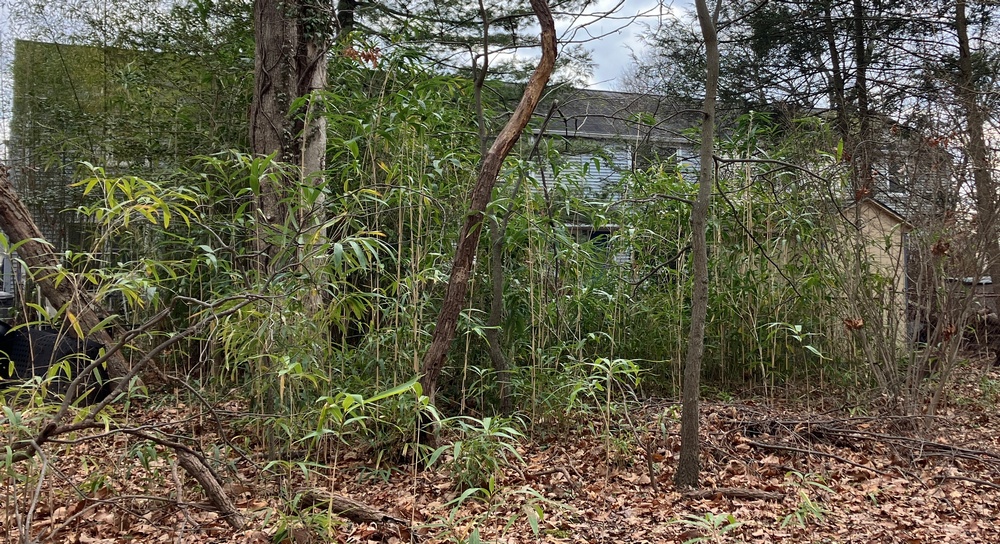
Tips: If you see your bamboo spread vigorously: it IS running bamboo (and not clumping bamboo). “Escaping the yard” is not defined. It seems reasonable to assume that if bamboo is neatly cut to the ground less than one foot outside the fence it is unlikely to be cited. On the other hand, if it expands more than a foot or so and becomes thinner as it expands in the woods, then the bamboo is not controlled and in the process of escaping the yard (as seen in the photo above).
Wanna help? There are many places where bamboo is no longer in a yard after escaping a long time ago, and it formed large dense patches in the woods, stopping all tree regeneration in that patch and possibly creating a fire hazard as well. The handbook does not require members to control those large old infestations in the woods, but members who are willing to help improve the health of the woodlands are encouraged to work with the Woodlands Committee (contact: woodlandscommitteeprojects@gmail.com) and consider joining the Volunteer Caretaker Program.
(9) Tree saplings sprung up in yard
The handbook requires members to remove tree saplings anywhere in their yard. Saplings are the young “volunteer” trees that usually grew from seeds carried by the wind, birds or squirrels, i.e. you didn’t plant them.
Practically speaking, the yard inspection has been extremely lenient regarding rules about tree saplings, but it is starting to change.
[Section 2.5.5.4.2 of the member handbook reads: “Members are responsible for removing tree saplings that have sprung up anywhere in their yard, paying particular attention to the garden, fence line, or hedgerow. These young trees may cause damage to fences, structures, swales, and other plants when they mature.”]
Here are examples of saplings that were allowed to grow from seed and should be removed. Many of the saplings are invasive trees which grow fast, and spread fast.
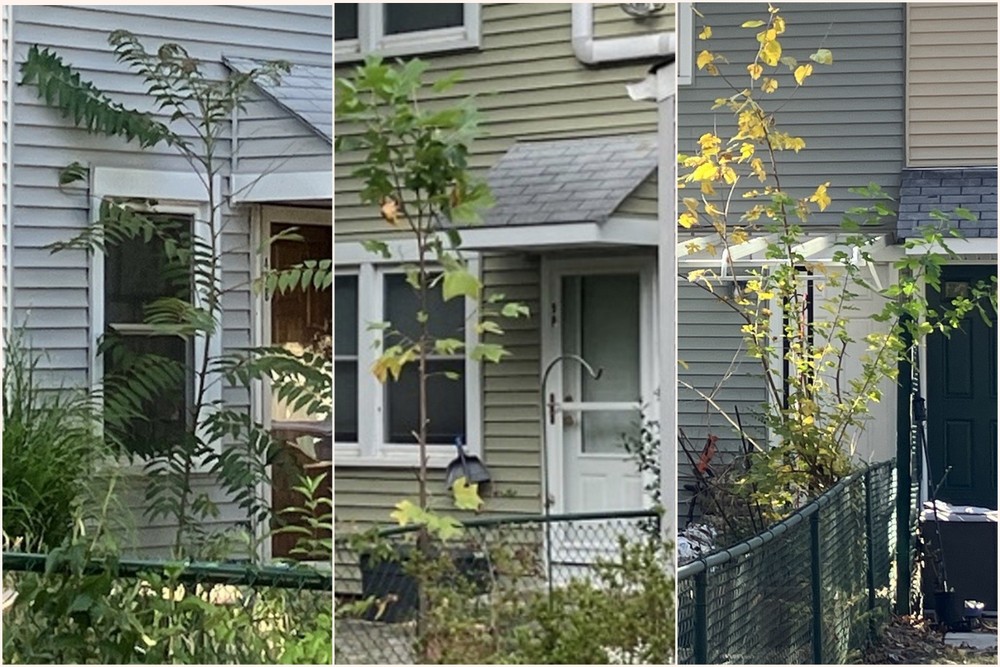
To prepare:
Remove the volunteer saplings from your yard, At least look carefully within 10 feet of your house and shed, but also all along fences and hedges.
If you wish to keep a sapling, contact Technical Services as soon as possible and apply for a permit. They will check that the sapling is not on top of a pipe, and that all the tree rules are respected. They will help you find a better location if needed.
Tips:
Because we are surrounded by mature trees, volunteer tree saplings pop up every year in most yards. A simple rule of thumb to find saplings might be: if it recently appeared in your yard, you don’t know what it is and it has grown significantly since last year, it is likely to be a tree sapling. They often grow next to fences, or in hedges – where ever it is hard to mow or weed.
Digging out the roots is best if you can. Cutting a sapling at the base is easier but they will grow back, so If you tolerate a small amount of herbicide in your yard, look for “stump and vine killer” products and apply just a few drops to the cut immediately after the cut is made.
If you are not an experienced gardener and cannot identify saplings you can try one of the many apps such as Seek, iNaturalist, PictureThis or Google Lens, but those apps make mistakes, especially for small saplings.
Some trees species such as black locust or poplars may also spread by suckers which should be cut as well.
Anything higher than 8 feet is the responsibility of GHI, so you may be cited but GHI has to remove it. Make sure they do that.
To keep fees down, remove your saplings:
Cutting a sapling when it is small takes a few minutes. Waiting several years will cost hundreds or a thousand dollars to the cooperative (i.e. us). Worse, if the sapling is growing near a pipe it may cost us tens of thousands of dollars when one of our old clay pipes is clogged. So to keep maintenance cost down we all need to remove all saplings in our yards when they are small. Remember to cut saplings outside your fence too, or the community (i.e. all of us) will have to fight a lot of invasive trees very soon.
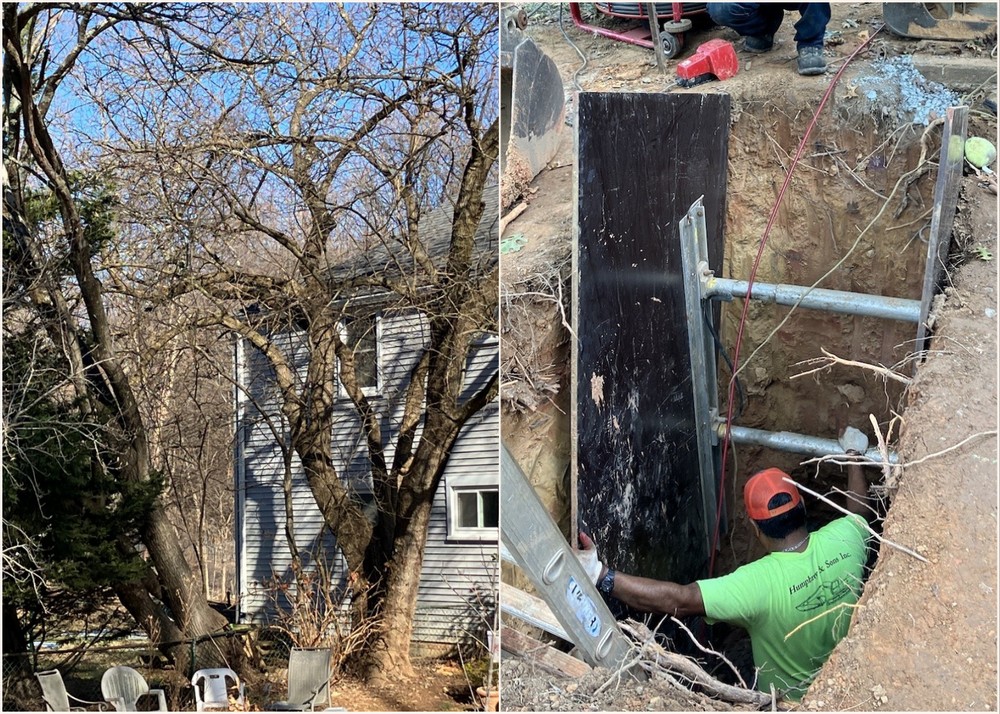
(10) Branches obstructing maintenance access to exterior walls
[Sec. 2.5.5.4.4 reads “Branches must be kept trimmed so they do not touch unit buildings in order to avoid structural damage and to allow access for regular maintenance (cleaning gutters or mildew from siding) and periodic repair (filling cracks in masonry). If a limb extends into a neighbor’s yard, the member(s) affected must reach agreement before pruning or removing a limb.”]
How to Prepare: Walk around your unit, trim branches away from the walls. Remove anything that may damage or impede access to the gutters, crawl spaces or electric meters.
Related tip: Section 2.5.5.4.3 reads “The maintenance department is responsible for mature trees and limbs eight feet above the ground surface in yards.” So if a problem branch is higher than 8 feet, you can ask Maintenance to trim or remove it, and it’s best to do that as soon as possible.
(13) Access lane not maintained
Access lanes are behind or on the side of your yard, behind fences and hedges in places where there are no walkways, e.g. at the edge of the woods. In case of a fire, firefighters would use those access lanes to quickly get to the back and side of houses while dragging heavy water hoses or ladders. Keeping them clear is a question of safety! Neighbors may also need to use them to access their backyard.
[Section 2.5.2.2 says: “Access lanes adjacent to yards must be well-maintained throughout the year by the adjacent member or members. Trees and brush on access lanes are cut and removed by GHI on an annual basis in order to keep lanes open.”]
How to prepare:
If any section of access lane is completely overgrown and has not been cleared by GHI in recent years, call GHI immediately and ask for the access lane to be cleared. If GHI came recently, then it is now your responsibility to keep it open.
Examples:
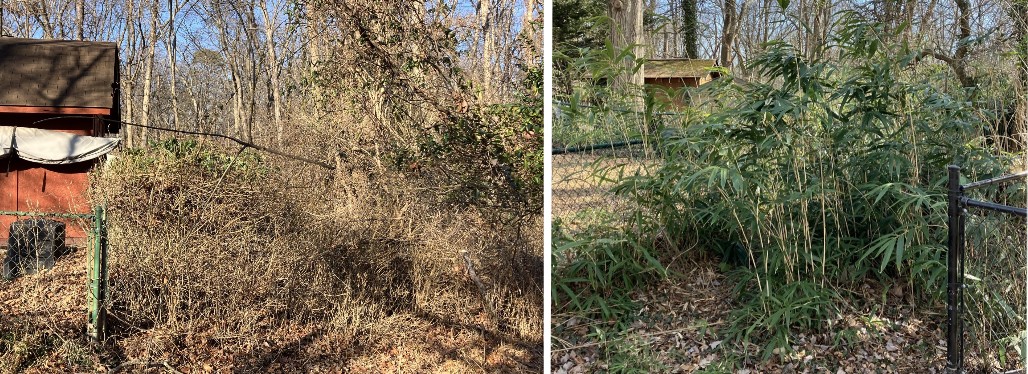
Tips:
- No reason to wait for the inspection: it’s a safety issue! Do it now.
- Abandoned equipment such as old lawn mowers can block access. Keep all equipment in your own yard.
- Remove any yard waste that was dumped in the woods. It is forbidden to dump yard waste in the woods [see Sec 2.5.2 of the handbook] for many good reasons: it can impede firefighter access, spread invasive plants, and might even add fuel to a wildfire right next to your house. Instead, bag or bundle your yard waste and call the City of Greenbelt for a yard waste pickup.
- Make sure that all your gates are functional as well.
- For your own safety, help your neighbors, as open access lanes may save all the houses in case of a fire.
- When in doubt, we recommend calling GHI in advance to see if they can clear the lane. Send photos.
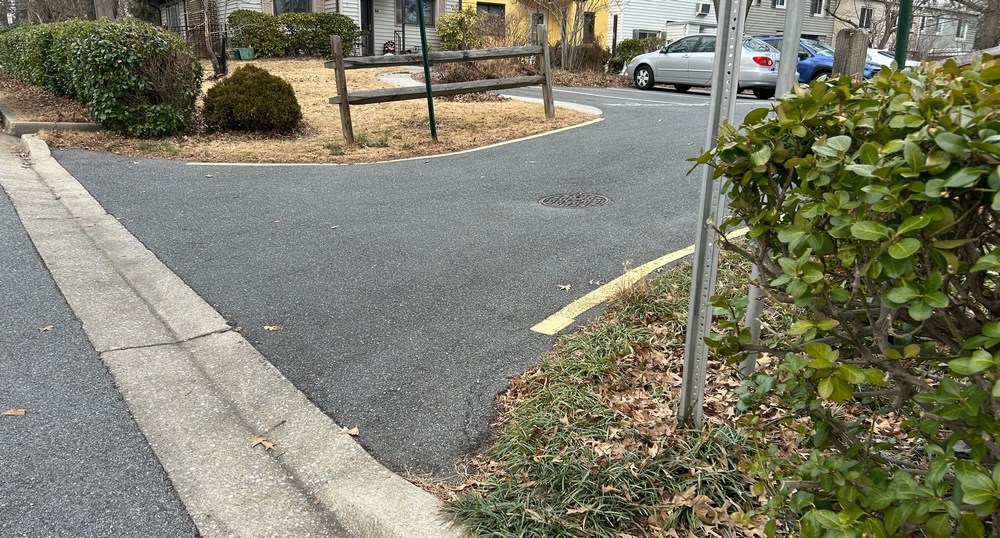
(J) Street, rights-of-way and court entrances hedge height above 42 inches
[Section 2.5.5.3 regarding hedges reads: “GHI and the City of Greenbelt require members to keep hedges trimmed back so they do not obstruct walkways, access lanes, parking lots and court driveways in either wet or dry weather. Hedges must be kept in a neat and uniform appearance at all times in accordance with Table 9.”]
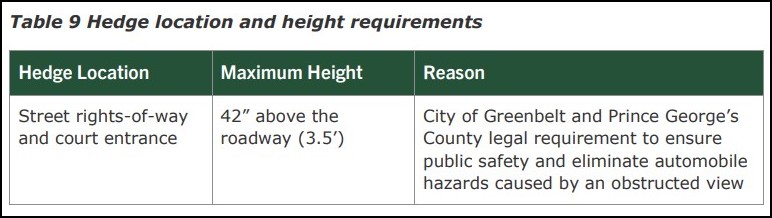
The city code on which our handbook is based is a lot more detailed and precise about the requirements. Chapter 18 of the city code reads:
- “(c) On any corner lot in a residential area at the intersection of public right-of-way, no fence, wall, terrace, structure, shrubbery, planting, tree or other obstruction to vision shall be erected or be permitted to
grow to a height over forty-two (42) inches above the paved roadway for a distance of twenty-five (25) feet back each way from the intersection, measured from the closest edge of the paved area of each roadway.” - “(d) On any corner lot in any residential area at the intersection of any public right-of-way and the paved entrance to any court or parking area no fence, wall, terrace, structure, shrubbery, planting, tree or other
obstruction to vision shall be erected or permitted to grow to a height over forty-two (42) inches above the paved roadway for a distance of fifteen (15) feet back each way from the intersection, measured from the
closest edge of the paved area of the roadway and the entrance driveway.”
To prepare: Trim all vegetation down to 42″ for a distance of 25 feet away from the corner for street intersections, and 15 feet for intersections with court entrances or parking lots. Note that the city code is not limited to hedges, but ANY vegetation or obstruction. This is an important safety rule to keep drivers as well as pedestrians safe.
Resources: See the section above on walkways.
(K) Bare spots in lawn (may be cited, depending on severity)
To Prepare: Plant something to cover the bare spots in your yard – or cover them with mulch.
Sec. 2.5.5 reads :”Bare spots on members’ lawns must be re-sown and maintained. Alternately, a suitable ground cover, mulch, or landscaping may be placed and maintained to cover all bare ground and prevent erosion.
Tips and resources:
- How to fill in bare spots in the lawn: this video makes it simple. UMaryland says the best times to plant grass seed in our climate are: mid-August to mid-October (best) or early March through April (second best).
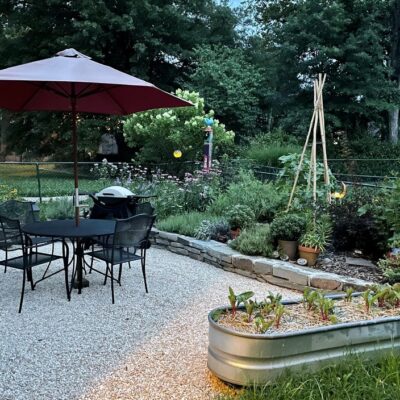
- For spots where it’s difficult to grow lawn, consider reducing or eliminating your lawn, using “Cues to Care.” It’s basically “How to turn your yard into a garden.”
- You can cover your bare spots with mulch.
- GHI provides good-quality wood chips for members to pick up. It’s called “arborist’s wood chips,” meaning it’s a mix of tree parts, in this case our own trees and branches that we saw being cut. The wood-chip pile is behind the GHI administrative building, behind a locked gate that’s only open during GHI office hours. GHI might be able to deliver a huge pile of wood chips with their front loader, near your unit or your court if you plan to share with neighbors. Often it is dropped on a pre-arranged parking spot. Contact Maintenance to arrange a drop. (And with mulch in general: never let it touch the base of tree trunks because that encourages tree rot.)
- The city has a so-called “mulch pile” at the east end of Northway Road, but it’s so decomposed, it looks and acts like soil and is best used not as mulch but to quickly improve the soil in gardens.
- If the bare spots are from too much foot traffic, perhaps a brick, stone or mulch path would solve your problem
- If your beloved dog is damaging your lawn, here are some tips for protecting your lawn from it.
Other Problems in our Yards
(3) Debris and trash/rubbish in yard
How to Prepare – Remove the trash. You know what it looks like! Anything abandoned outside for months will look like trash, so don’t be surprised if you’re cited.
[Sec 2.5.2 reads “Yard areas must be neat in appearance and free of trash and debris.” Section 6.2.2 reads “It is unlawful to accumulate or store in open view to the public any brush, trash, building material, or waste materials from building or remodeling operations, debris, packing boxes, rubber tires, automobile parts, disabled or unlicensed motor or other vehicles, trailers. and the like. City code, chapter 17 mirrors these same requirements.]
Tips and resources
- The rule goes on to say: “The dumping of trash, clippings, debris, etc. in common areas, woodlands, or curbside is not allowed.” If you have piles of yard waste, call the city of Greenbelt and prepare for a special yard waste pickup.
- For large objects you can ask the City of Greenbelt for a special trash pickup .
- No dumping in the woods, even yard waste! It is strictly forbidden, an eyesore for everyone, and often adds more invasive plants to the woodlands.
- Donate unused items when appropriate.
(4) Pet waste to be removed.
How to Prepare: Another cut-and-dried rule. Just remove it.
[Sec. 2.5.2. reads “Pet feces must be promptly removed and properly disposed.”]
Tips and Resources: How pet waste is harmful if left in the yard.
(6) Swales obstructed.
[Sec. 2.5.10.1 reads: “The depressed channels in which storm water flows through some members’ yards is a part of the city’s stormwater drainage system. Swales are part of the original GHI design and are a natural way to control runoff and promote drainage. In performing any yard alteration work, it is highly important not to change the grade level of the swale; otherwise, damming of water results. Changing the grade level of a swale is prohibited. Yard swales cannot be blocked in any manner.”]
To Prepare: Remove anything blocking your drainage or swale.
Tips and resources: From Anne Arundel County.
(11) Trailer/vehicle stored in yard
[Sec. 4.11.2. says “No vehicles, including trailers, campers, and boats may be parked in yards or any area owned by the cooperative, other than the boat and trailer lot.]
How to Prepare: Just remove it!
Under Maryland law, which applies to Greenbelt, bicycles and adult scooters are considered vehicles, so remove that old broken scooter from your yard too. Bicycles are unlikely to be cited if they look like they’re being used.
(D) Store toys and tools (may be cited, depending on severity)
How to Prepare: Store the tools, toys, etc. so it doesn’t look like a mess.
[Sec. 2.5.2. says “Yard tools, mowers, wheel barrels, toys, and miscellaneous items must be neatly stored.”]
Tips:
- Donate the toys your kids don’t use any more.
- Keep those items clean, and store them neatly together.
- Avoid hiding your stuff under your deck, as it is a major fire hazard.
(G) Wood improperly stored (may be cited, depending on severity].
[Sec. 2.5.2.says “Firewood not exceeding one cord (a stack four feet high, four feet wide and eight feet long) must be neatly stacked not less than six inches from the ground and not less than 10 feet from the unit building.]
How to Prepare: Make sure your woodpile isn’t too big or too close to the house.
Problems with structures
Damaged fence (#12), shed (#A), window screen (#D), window (#F), or storm door (#H)
Re fence, Sec. 2.5.6.1 provides details per type of fence. Re shed, Sec. 2.5.8, says “All sheds must comply with shed regulations, be structurally sound, have surfaces free from damage and rust, and be properly maintained. Storage sheds are used to store items like bicycles, garden tools, lawn mowers and porch furniture. Any structure used for storage, regardless of shape or size, is considered a shed.” Re window screen, broken window and storm door, Sec 2.4.6. says “All screens and glass must be intact with no tears, cracks, or holes. Storm or screen doors must be in good condition; this means no holes in screen materials, the glass is intact, and door frames are properly sealed or painted. Storm or screen doors must be in good condition; no holes in screening materials, glass intact, and door frame properly sealed or painted.”
To Prepare: Fix damages like these to your unit, etc.
(B) Paint fence (may be cited, depending on severity)
[Sec 2.5.6.2.1. says “Chain-link fencing must be maintained and free of paint chips, scratches and rust. Any fence painted with a prior-approved fence paint color (black, brown, or forest green) may have imperfections (scratches, chips and rust) touched up if less than 25 percent of the surface area needs touch-up.” But if the neededrepairs exceed 25 percent, the fence “must be painted or coated in black, brown, or forest green only. Paint must be exterior metal rated.” The form mistakenly shows the rule section as 2.5.6.1., which are the standards for constructing fences.]
(C) Peeling paint on walls (may be cited, depending on severity)
How to Prepare: Fix peeling paint.
[Sec, 2.4.7 says “All chipping, cracking, or peeling exterior wall paint or trim paint must be corrected as directed by GHI.”
(I) Mold/mildew/algae on exterior walls (may be cited, depending on severity)
[Sec 2.4.7. says “Mold and mildew must not be allowed to accumulate on exterior wall surfaces.]
How to Prepare: Get rid of the mold and mildew.
Tips/Resources:
- For minor problems on vinyl siding: it’s surprisingly easy. Use a slightly wet sponge (that you rinse often), then wipe with a dry cloth. Sometimes the dry cloth may be enough, or a broom to wipe the accumulated dirt.
- More serous vinyl siding problem: see this video to use vinegar, a brush and a water hose.
- Even worse conditions? You can borrow a power washer from GHI, but watch out, it will blow away the paint of the HVAC tubes!
- Be very careful not to push water under the siding.
- You can borrow ladders from GHI, as well.
- Your fences may need cleaning, too.
(L) Trash enclosure damaged (may be cited, depending on severity).
[Section 6.2.1.1 says: “Containers must be kept in clean, safe, and sanitary condition and out of public view. Trash must be placed in a trash closet, trash container cabinet, or screened (hidden from view) area on the side of the unit.]
All units have a trash enclosure when we buy them, but unlike closets, the external enclosures that are made of wood or vinyl can get damaged, and sometimes members make the mistake of removing them entirely. They will be cited for a missing trash enclosure.
How to prepare: Fix or reinstall your trash enclosure.
What happens if the form says “Your yard needs some work”?
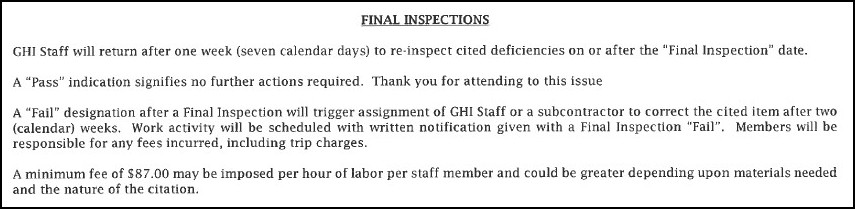
After your yard has been inspected you’ll find a yellow form attached to your front door. It’ll either say “Your yard PASSED. Thank you for caring about your neighbors and community.” or “Your yards NEEDS SOME WORK to meet GHI’s minimum exterior standards.” You’ll also see in the upper right-hand corner the “Final Inspection Date,” which is your deadline for correcting the cited problem(s).
The back of the form shows what free help is available from GHI: tools to borrow (extension ladders), scrub brushes and extension poles, paints and house numbers (stick-on 3″ tall) that are available at the Maintenance Department. (We’re told by staff that GHI no longer lends ladders to members.)
The back of the form also explains what happens if you don’t correct the deficiencies by the deadline, “Work activity will be scheduled without further notification. Members will be responsible for any fees incurred, including trip charges. A minimum fee of $87 may be imposed and could be greater, depending on the nature of the citation.”
If you can’t fix the cited problems yourself but want to avoid paying GHI an unknown amount to do the work:
- No-cost options include asking a neighbor or friend for help, or the Greenbelt Timebank.
- Hiring someone in advance of the inspection (or after the first inspection but before the final inspection date) is likely to be cheaper than GHI doing the work. Currently there’s a minimum charge of $87/hour for Fee-For-Service work, and it could be higher depending on materials needed, etc.
What to do if you are cited by mistake
If you’re cited by mistake: don’t panic, it’s probably a mistake that can be corrected.
For example: the inspectors are not trained enough to identify plants accurately, so they may think that your shrubs – such as a lilac or camellia – are tree saplings. Complaining on social media will have no effect whatsoever. Instead, write immediately to the contact person indicated on the inspection form. In the case of a misidentified plant you might provide the correct ID for the plant and explain that it is not a tree (adding reputable info about that species is a plus). You may not hear back… so if you are really anxious, you might add a tag to your precious shrub until the end of the correction period. e.g. “This is a lilac, not a tree. Do not remove it”.
More Information
Why do we have yard inspections?
When we bought our units we all signed a “Cooperative Housing Proprietary Lease and Mutual Ownership Agreement ” that stated that we “agree to observe and comply faithfully with [the] rules.” We were also provided with a copy of the Member Handbook, which lists all those rules. The board of directors has instructed staff to conduct the yard inspections, as an important tool in enforcing the rules we promised to follow.
The inspection program was originally called the Community Beautification Program, reflecting its purpose – keeping our community attractive and well-maintained. Without rules and a way to enforce them, we could gradually see more GHI homes look shabby, like much of the original housing in Greenhills, Ohio. They were all sold to private owners, rule-free. in the 1950s.
Who are the inspectors?
The GHI maintenance director assigns 2 or 3 maintenance staff members to work on the yard inspection. Some may be part of the small ground maintenance crew but they may also be plumbers or carpenters. They work as a team at first to try to use the same consistent process, then they start working individually to speed up the overall process.
In the past 10 years at least, none of the inspectors seemed to have much experience in plant identification or gardening. We can expect that English Ivy and bamboo and possibly crapemyrtle may be recognized easily, but your inspector may not know how to identify classic garden shrubs such as wisteria, lilacs or spicebush. They will have a hard time telling if a small plant is a tree or a shrub, as this requires years of training or experience to do reliably. But until or unless we convince GHI to hire people with more plant knowledge as inspectors (and we agree to pay for it), we have to expect mistakes to be made in plant identification. Remember that it is not the fault of the yard inspectors.
Comments, questions?
We welcome your ideas for making this resource as helpful as possible. So if you have questions we don’t answer here, or want to comment on something, just leave a comment at the bottom of this article OR email Susan using editor@greenbeltonline.org. We’ll do our best to get your questions answered and keep this article up to date.



Claude A. Aubert
Last time I tried to get a ladder from GHI (about 21-3 years ago) they said that they no longer let members borrow ladders. Has this changed?
Susan Harris
Apparently not because the staff just confirmed to me today that they no longer loan members their ladders. Thanks for the tip and I’ve made the correction in the article.
Kathy Bartolomeo
Tons of great information. Thanks for all the work, Susan and Catherine.