


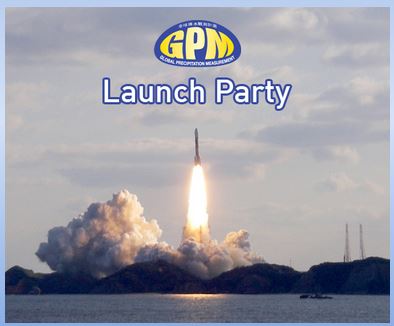
I was hoping to post this article as an invitation to join Goddard’s Launch Party this week, but it turns out that space is limited, and they’re full up. Fortunately they’re making room for this blogger and I’ll do my best to convey the excitement, and maybe a bit of the science behind this historic event. And – good news! – it’ll be shown LIVE on NASA’s TV station. (And there’s more – scroll down to read about post-launch events that are available anytime.)
So, what’s the big deal? It’s the second-in-history launch of a Global Precipitation Measurement (GPM) satellite, the first one since the mission started in ’97. The information gathered by the new, more advanced satellite will help the world track and predict really important events – climate change, floods, hurricanes, and landslides. Yeah, those events. And while the existing satellite just covers precipitation in the tropics (latitudes 35N to 35S), the new one will cover a much wider area – 90% of the earth’s surface.
The satellite being launched was built at Goddard and is the largest one ever constructed there, so the folks at Goddard folks are super-stoked about this. A bit more information about the satellite, none of which means a thing to humanities major: It’s comprised of a bus (power systems, thermal control systems, attitude adjustment systems, communications systems) and the scientific payload (a dual-frequency precipitation radar system, and a passive microwave scanning radiometer for imaging. It’ll provide a CAT scan of the precipitation systems with 3D information, plus an X-ray with larger coverage but less detailed information. Got that?
Though constructed here in Greenbelt, the satellite was shipped to the Tanegashima Space Center in Japan, where the launch will take place – weather permitting, meaning not too much wind. The Japanese launch is hoped to bring more attention and support to their satellite program.
The Launch
Locally, we’ll be watching the launch on a presumably large screen at the Goddard Visitors Center this Thursday afternoon. The event will also include a prelaunch briefing, hands-on activities, a showing of the film “WaterFalls”, plus booths with educational activities about weather, climate, freshwater, and satellite technology.
 Post-Launch “Rain EnGAUGE” Events
Goddard is also assisting people in hosting “Rain EnGAUGE” post-launch events for the community, to tell folks about the mission, share information on STEM-related content and career options, and engage multiple generations in the excitement of the launch and science behind the GPM mission. It can be a family science night at your school or at an outdoor education center, library or museum. Just contact Goddard if you plan to host an event so that they can send you a supply kit with GPM stickers, water droplet handouts, lithographs, and other materials to help you run your activities! (See the cool resources available for download here.)


Leave a Reply