


Hedges in Historic Greenbelt seem to be everywhere, and we have them because they’re part of the original utopian plan: yards that are open to each other, so that residents socialize together as a neighborhood. (Gardening was to be done in community gardens.)
That’s why no privacy fencing was installed between yards or along sidewalks, just short hedges, no taller than 42 inches high.
Over the years, height limitations on hedges were removed, which added to the many problems caused by hedges that exist today. When polled as to how members would like the yard inspection improved, a common answer is their desire for sidewalks cleared of overgrown vegetation.
Scroll to the bottom of this page to find what I’ve been able to learn about Greenbelt’s original landscape plan, including the role of hedges. And thanks to the Greenbelt historian Stephen Oetken for his well-researched input.
Problems Caused by Hedges Today
Hedges are high-maintenance and the maintenance required is high-skill
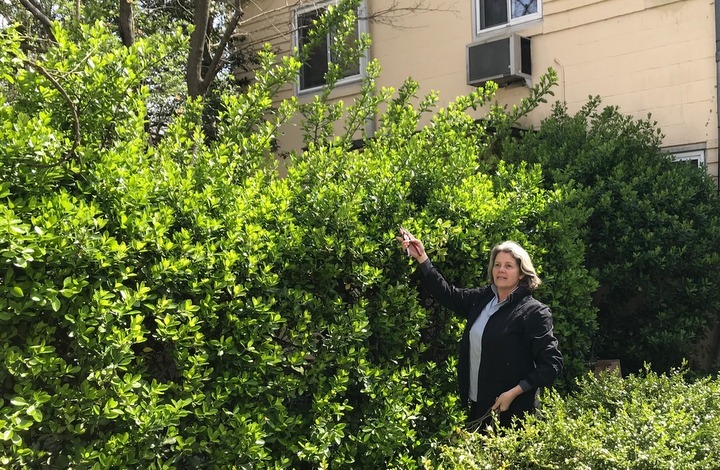
Pruning hedges, especially in tight spaces like ours, is an advanced horticultural skill. Proper pruning technique for health and reduced maintenance over time isn’t intuitive at all and requires experience. So Greenbelt Online hired a professional, highly skilled pruner to come show us how to do it. Here’s her advice, with photos and video.
So requires more than skill – hedges can steal your time! One member in an end unit told me it takes four full weekends to trim their hedge, twice yearly.
The expense of hiring pruners
That same member told me they’ve paid between $600 and $1,500 for someone else to prune their hedge, depending on their skill level.
The species used are poorly suited to the job
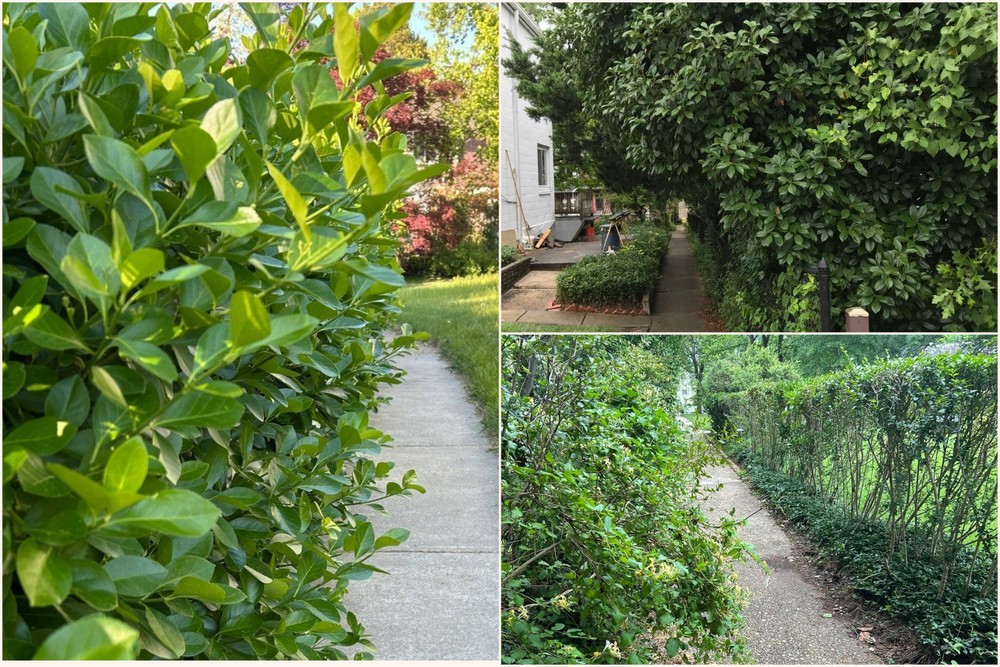
Almost all our old hedges are privet or euonymous – both nonnatives that aren’t even well-adapted nonnatives. One is listed as an invasive plant in our region.
About privet, according to UMD, “All species of privet present in Maryland are invasive and spread into natural areas by seed. Birds eat the berries and aid in seed dispersal. Border privet and European privet in particular can form dense thickets in natural areas and impede the growth of native plants, such as spicebush in the forest understory.”
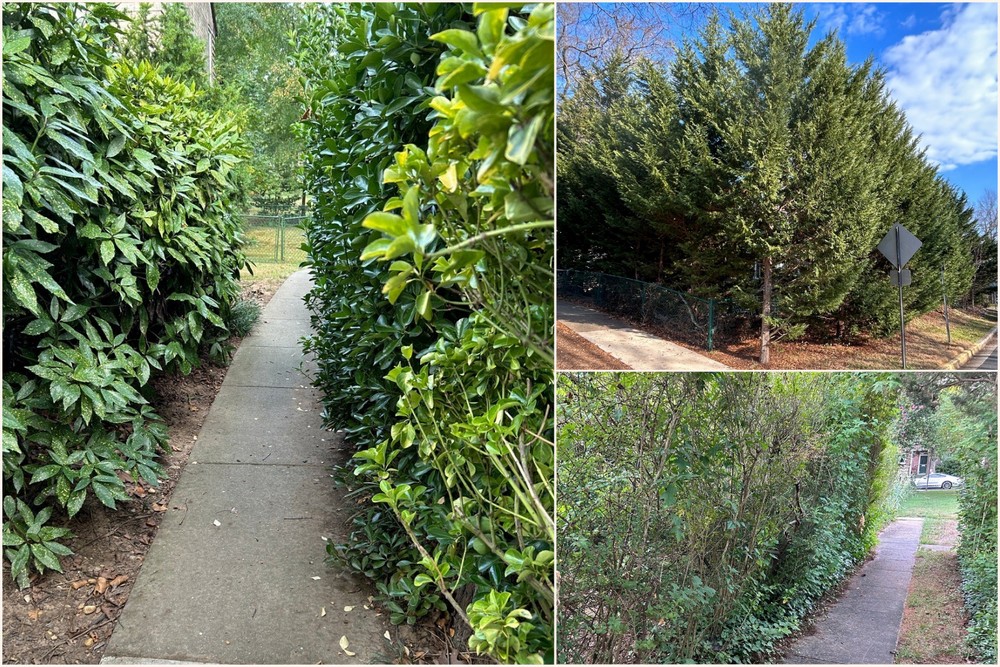
Many hedges simply don’t get enough sun to fill out and be healthy – see the example in the collage above. Awfully leggy.
About euonymus, Greenbelt historian Stephen Oetken tells me that the ones planted here were “varieties of the plain green Euonymus (typically Euonymus japonicus), praised for its dense, glossy foliage. It doesn’t seem to be on the market anymore; the closest I can find is the narrower version – ‘Green Spire’ is a narrow, columnar evergreen reaching 6 to 8 feet tall and 1 to 2 feet wide, perfect for tight spaces. Needs at least 3 hours of direct sunlight to maintain its dense vertical form. There are lots of diseases and pests known to affect euonymus.”

Many species chosen by members as hedges or other evergreen screening eventually become far too large for the site. Above left and right are two conifer examples; in the center is a photinia, which is far too large and very prone to leaf blight.
The expense of buying new or replacement shrubs
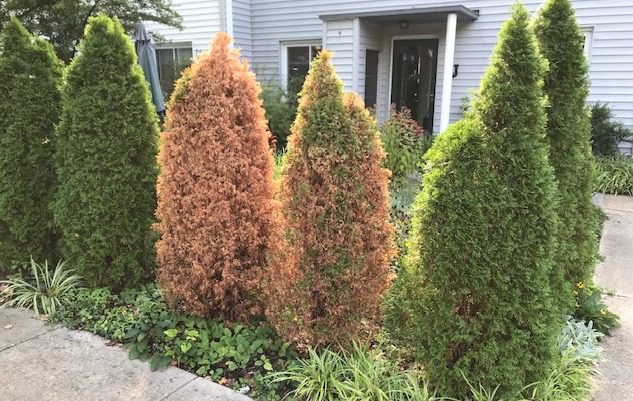
I started a arborvitae hedge in 2015 and four years later it looked like this. It shouldn’t have surprised me, given that they’re not particularly drought-tolerant. But I had no irrigation system and I didn’t do as much hand-watering as I should have, so I wasted about $900 on arborvitae. With hindsight, even if they’d survived the drought, arborvitaes were the wrong shape to block my view of the parking lot – their primary purpose.
I wasted another $450 on five evergreen Cryptomeria trees to block the view on the garden side of some garages – another conifer that proved to be too large and the wrong shape for screening where I needed it.
Monocultures of single species are especially vulnerable to disease, and all it takes to spoil that perfect hedge is one plant’s demise. Instead, experts recommend hedges with a mixture of species.
Waiting years for the desired screening, if ever
For new hedges to create adequate screening is at least a five-year wait, and there’s no guarantee that the new hedge will ever create the evergreen blockage where it’s needed.
Problems for the community
Branches hitting humans, even cars
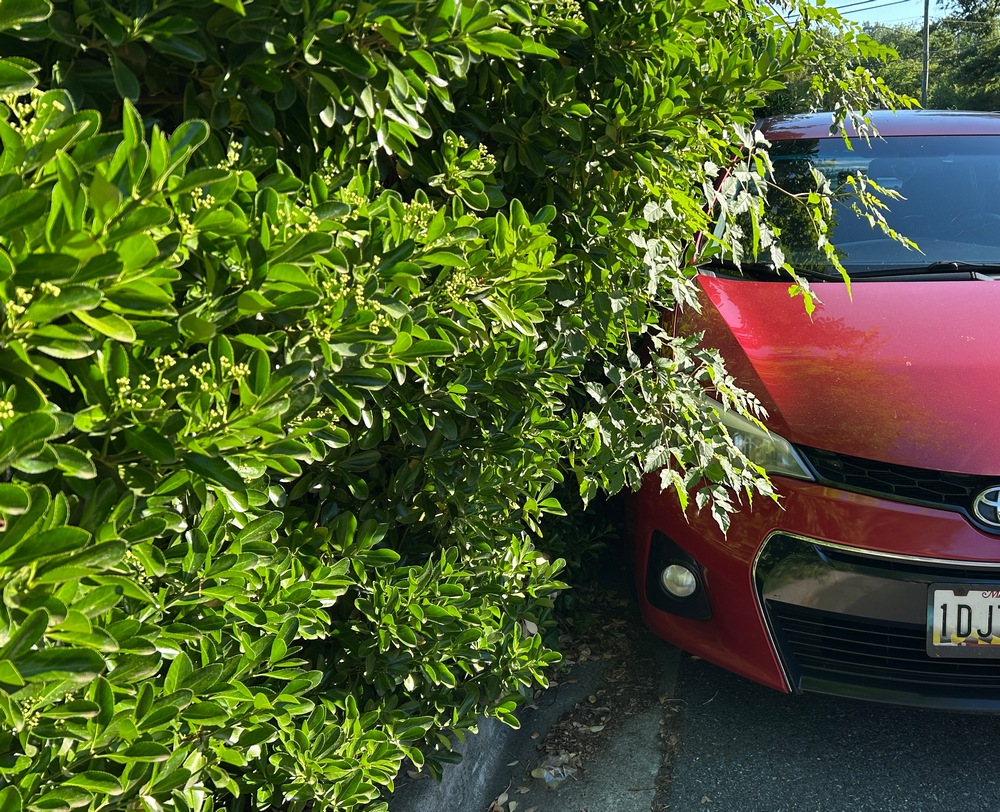
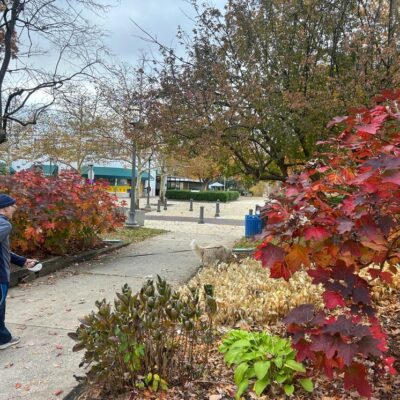
This is a common complaint heard among members – hedges impinging on inner walkways and sidewalks along the street, as shown here.
Reducing safety and/or the feeling of safety from harm-doers
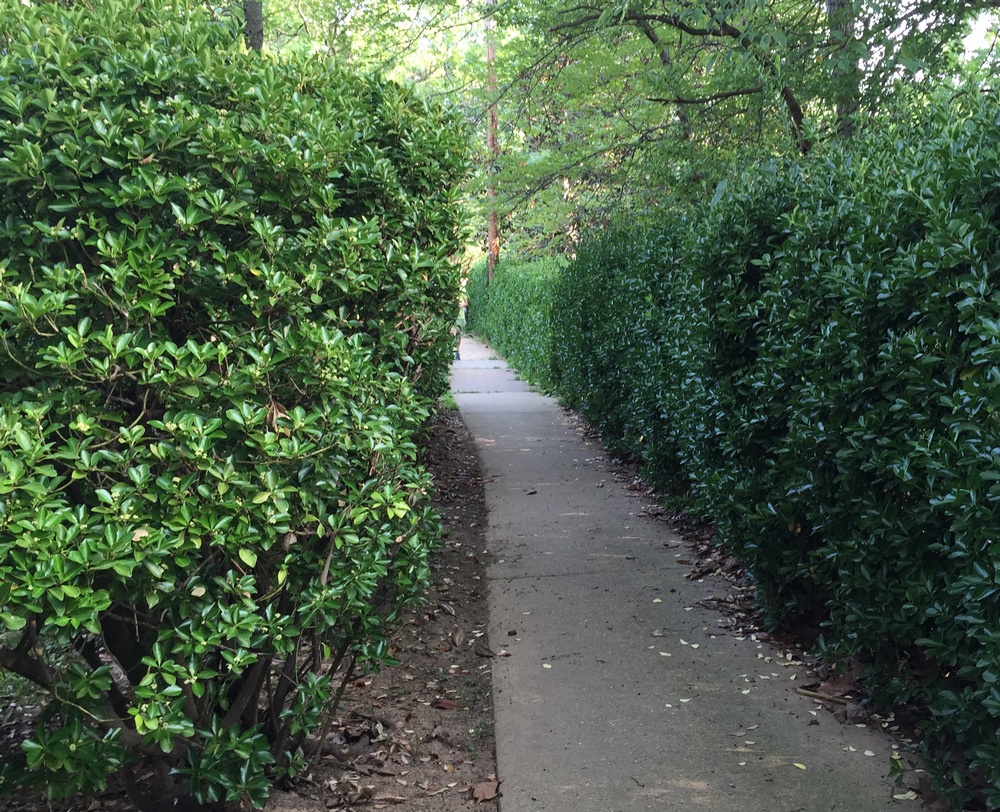
The original 42-inch hedges allowed pedestrians to see people coming from every direction. Now, tall hedges like these can harbor criminals, or at least create the feeling of danger for pedestrians, especially when walking alone at night.
Contrary to the intended openness, hedges have walled off parts of our community,
How we got here:
The History of Greenbelt’s Landscape Plan and Rules
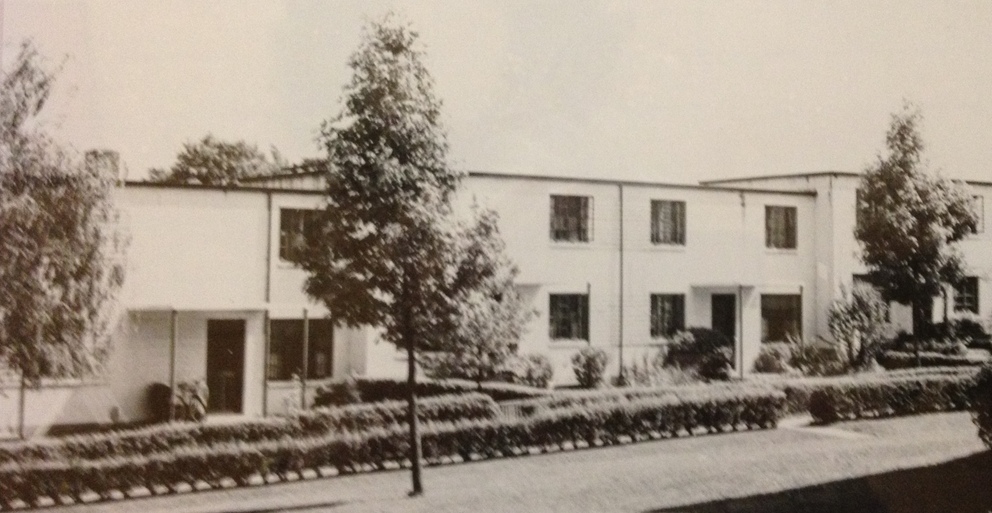
Greenbelt planners reversed front and back doors, then added hedges
If you’re not familiar with Historic Greenbelt’s creation as a New Deal project and its design origins in Europe’s Green City movement, the Greenbelt Museum’s brief history is here. Of all the unique things about Historic Greenbelt, one that’s not well known is how we got our ubiquitous hedges and why our front and back doors are reversed.
The Utopian Vision of an Open, Park-like Greensward
Some of the most interesting features of Greenbelt’s original plan from the mid-1930s are its efforts at social engineering that are unimaginable today: quotas for each religion, choosing residents by marital status, excluding Black residents, requiring laundry to be brought indoors by 4:00 when husbands came home from work, et cetera.
And one of the planners’ primary goals was to separate pedestrians from the streets. That’s why the architectural “front” of our homes faces not the street but inner sidewalks, which residents were intended to use to approach their homes. (This reversal was also implemented in Greendale, Wisconsin, where the result is what they call ‘backward houses’.)
Apparently this heightened concern for pedestrian safety was due to a recent rise in accidents involving pedestrians. But as cars got more popular it must have been clear pretty soon that the backward-house experiment didn’t ultimately change behavior.
Greenbelt’s Plan and Gardening
While practices like religious quotas are long gone, Greenbelt’s utopian landscape features have proved more long-lasting, and they impact residents to this day. That’s primarily due to the requirement that garden-side yards be open to the neighborhood, without the 6′ tall fencing typically installed in townhouse back yards. Individual yards were intended to flow into open public space that residents would use communally.
So while residents who wanted to grow food could do that in community gardens, there was no thought given to residents creating gardens around their homes. (This is very typical of the era. Homes didn’t open to views of the garden. Windows were covered with layers of fabric. This was before magazines touting “outdoor living.”)
I asked Greenbelt historian Stephen Oetken about these unique features of Greenbelt’s plan:
The reversal of the traditional front and back yards was an important planning element towards the goal of having a more “communal” society – where social interactions were not hindered by landscape or house design. That was vitally important in Greenbelt’s early days, as the success of the town would be measured by the participation of its residents in the social, economic, and governance functions of the town. “Privacy” was not a primary concern or goal. Hence, doorways opened facing other doorways in the court, and doors were not hidden with private access. Hedges were required to be trimmed down so that you could not “hide” in your yard, and the community would have a wide-open feel.
The only U.S. precedent I can find for “backyard houses” and residential yards as communal spaces is Radburn, a community in New Jersey just outside New York City. (There are more in Europe.) Then after Greenbelt was built, only Greendale followed suit – and their homes are on much larger lots and about half are single family homes. The third “greenbelt” city (Greenhills, Ohio) did not adopt these features.
After Greenbelt’s federally owned units were bought by the member co-op in 1952, several rules were changed to accommodate residents, most notably allowing pets and fences, and taller hedges. More from Stephen:
But once these planning elements were altered – additions, taller hedges – the reversed yard feature became a rather diminished factor. Service sides became primary to garden sides because of parking. So today, it does not seem that it’s very revolutionary. However, we still have the walkway system, and we still have service sides facing one another with close proximity, so the elements are still there that can enable residents to participate communally.
And almost no one enters their homes as planners intended – from the garden side – because it’s typically farther from their car.
On a positive note, the inner sidewalk plan, including the underpasses that are beloved by residents and historians, works quite well for residents in some spots. But other areas are dangerously lacking in sidewalks where they’re needed – along our primary streets.
How Greenbelt Got Hedges
From Stephen Oetken:
In the beginning, Greenbelt’s creators planned and executed an extensive landscape plan, which included hedges for most units on the garden side. The “rules manual” handed out to residents stressed that the care and maintenance of the hedges and landscaping was up to the tenants. Frustratingly, this manual does not specify a specific height for the hedges.
Generally, the height (at installation) is referred to as 18 inches tall, though Stephen tells me he can’t find where that number originated. “Needless to say, the intent of the planners was that hedges should be kept and trimmed by the residents, and that the height of the hedges would allow for neighbors to easily interact, and were not intended to give what we would consider as ‘privacy’ within individual yards.”
So the hedges served no functional role except to mark yard lines and keep people from walking across them. They’re primarily ornamental, in the very tidy, controlled style of the day.
Hedge height limit imposed at some point, but enforcement was onerous, so it was eventually ended
According to Oetken:
It seems that the hedge trimming was not monitored by the federal government during the war, as there are plenty of articles in the Greenbelt Cooperator throughout the late 40’s to suggest that the landscaping around the homes had become overgrown and unkempt, and that the federal government would crack down once again on hedges that were too high and lawns that were unkempt.
Then at some point, there was a height limit of 6 feet placed on hedges, which seems to have lasted a long time. According to what former general manager Eldon Ralph told me, the staff told the Board it was too difficult to enforce the limit, so the Board allowed them to stop trying. Several years later the Handbook’s height rule was removed, to conform with that new policy.
The result is what we see today.




Leave a Reply